
Why the Manufacturing Side Matters to Buyers
A disposable pet training pad seems like a modest everyday item. Behind that simple look, however, sits a surprisingly exact production discipline.
The way a pad is manufactured dictates how fast it absorbs, how well it holds liquid, how reliably it blocks leaks, how uniform it stays across shipments, and ultimately how customers judge it. For importers, distributors, and private-label brands, a strong manufacturing partner does more than fill an order — it protects product reputation and keeps the supply chain predictable.
The Core Ingredients of a Training Pad
Performance starts with what goes into the pad. Serious manufacturers build a pad from several cooperating layers rather than a single lump of absorbent material.
The Non-Woven Topsheet
The topsheet is the surface that meets the pet. It has two jobs: let urine pass through quickly and feel comfortable to the touch. Typical choices are PP (polypropylene) non-woven fabric and hydrophilic treated non-woven fabric. A good topsheet balances penetration speed, surface dryness, and skin comfort.
The Absorbent Core
The core is where the real performance lives. It normally pairs Super Absorbent Polymer (SAP) with fluff pulp. SAP draws liquid in and turns it to gel, raising capacity and cutting leak risk. Its quantity and distribution steer absorption speed, retention, and overall performance. Fluff pulp spreads moisture evenly through the core and lends it structure.
The Waterproof PE Film
The bottom film keeps liquid off the floor. A dependable film should be waterproof, flexible, and quiet in use.
Adhesives and Edge Materials
Hot melt adhesive and edge-sealing materials bind the layers and keep the pad stable during shipping and daily use.
From Roll to Pad: The Full Production Route
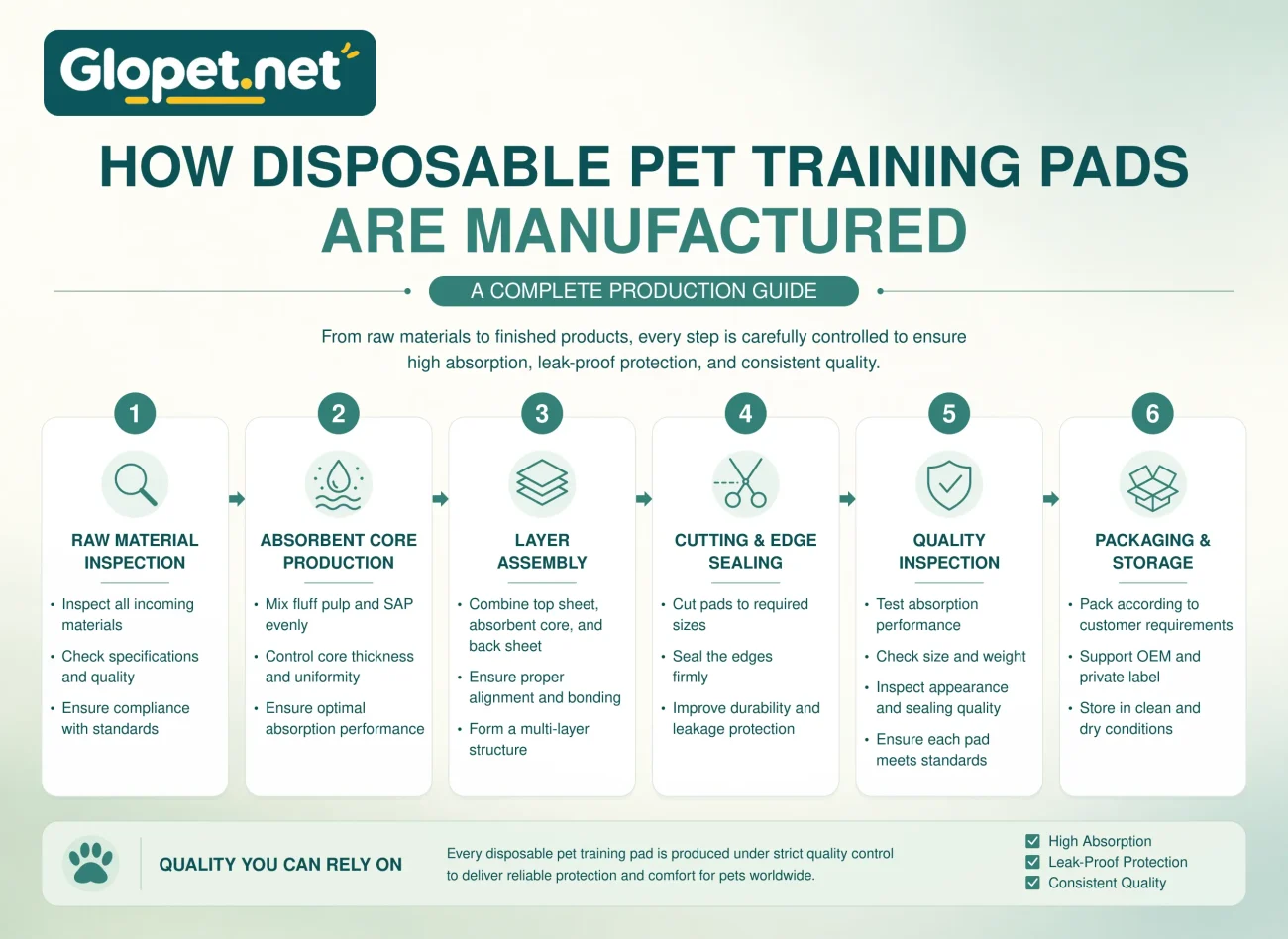
A clean, repeatable production line is what turns raw materials into finished pads. Each stage has a clear purpose.
Stage 1: Incoming Material Checks
Materials are screened before they enter production. Typical checks cover specifications, weight consistency, appearance, and supplier compliance. Catching problems at the gate stops defects from forming downstream.
Stage 2: Core Formation
Pulp and SAP are blended into an even absorbent layer. The line controls SAP distribution, pulp thickness, and core uniformity. If the mix is uneven, absorption slows, liquid pools, and leaks follow. Consistent machine settings are the backbone of reliable quality.
Stage 3: Layer Lamination
Automated equipment joins the layers: topsheet, absorbent core, and PE film. Automation keeps the layers aligned and bonded firmly.
Stage 4: Cutting and Edge Sealing
Continuous rolls are converted into individual pads at customer-specified sizes. This step cuts pads to size, seals the edges, and fixes the final shape. Clean edge sealing boosts durability and lowers leak risk in use.
Stage 5: Finished-Goods Inspection
Pads are checked before packaging. Typical checks cover absorption behavior, size accuracy, appearance, and edge sealing.
Stage 6: Packing and Dispatch
Approved pads are packed to the buyer’s requirements — retail packs, bulk cartons, or private-label packs. Flexible packing lets brands serve different markets.
How Absorbency Is Tuned During Production
Fine-Tuning SAP Levels
SAP quantity and grade shape capacity directly. Manufacturers set SAP levels to match market positioning, required capacity, and target price.
Designing the Core
A well-built core spreads liquid across the whole pad. A flawed core can produce slow uptake, surface wetness, uneven spreading, and extra leak risk.
Holding Consistency
For exporters, what matters is that every shipment behaves like the last. A reliable maker keeps stable specifications, absorption performance, material structure, and production standards.
Keeping Quality Steady Through QC
Incoming Material Checks
Before production, confirm specifications, consistency, and compliance.
In-Line Monitoring
During production, watch machine behavior, material distribution, dimensions, and layer bonding.
Final Testing
Before dispatch, verify absorption, leakage, packaging, and quantity. A complete QC system lowers supply risk and supports long-term partnerships.
Tailoring Pads and Packaging for Export Markets
Product Customization
Buyers can adjust size, thickness, capacity, SAP content, and material mix. Different settings serve everything from budget lines to premium ranges.
Packaging Customization
Packaging drives shelf appeal and brand recognition. Options include printed bags, retail packaging, bulk cartons, and private-label branding. A capable OEM supplier tailors packaging without slowing production.
Positioning Options
Economy tier: low cost, basic absorption, volume distribution. Standard tier: balanced quality and price, reliable daily use, wide market fit. Premium tier: higher capacity, better materials, and extras such as odor control.
Red Flags to Check Before Choosing a Factory
1. Manufacturing Capability
Look at equipment, track record, capacity, and large-order handling. Strong capability supports stable supply and consistent quality.
2. Development Ability
A capable maker helps with new product design, specification changes, material upgrades, and packaging solutions.
3. Quality System
Understand raw-material checks, in-line monitoring, and finished-product testing.
4. Supply Dependability
For distributors, steady supply is everything. A solid factory supports regular schedules, seasonal swings, and long-term partnerships.
The Takeaway: Finding the Right Partner
Making a training pad is far more than stacking layers. Results come from material selection, machine control, process discipline, and inspection. For brands, importers, and distributors, the right manufacturer reduces supply risk and delivers products customers trust.
A professional partner should offer reliable production, consistent quality, flexible OEM support, and solid supply-chain backing. At Glopet, we deliver reliable disposable pet hygiene solutions through disciplined manufacturing, OEM capability, and quality-focused management. Whether you are building a private-label line or sourcing wholesale pads, the right partner is the foundation of long-term success.
Looking for a dependable disposable pet training pads manufacturer for your brand or distribution business? Contact the Glopet team to discuss OEM solutions, customized pads, and wholesale cooperation.