
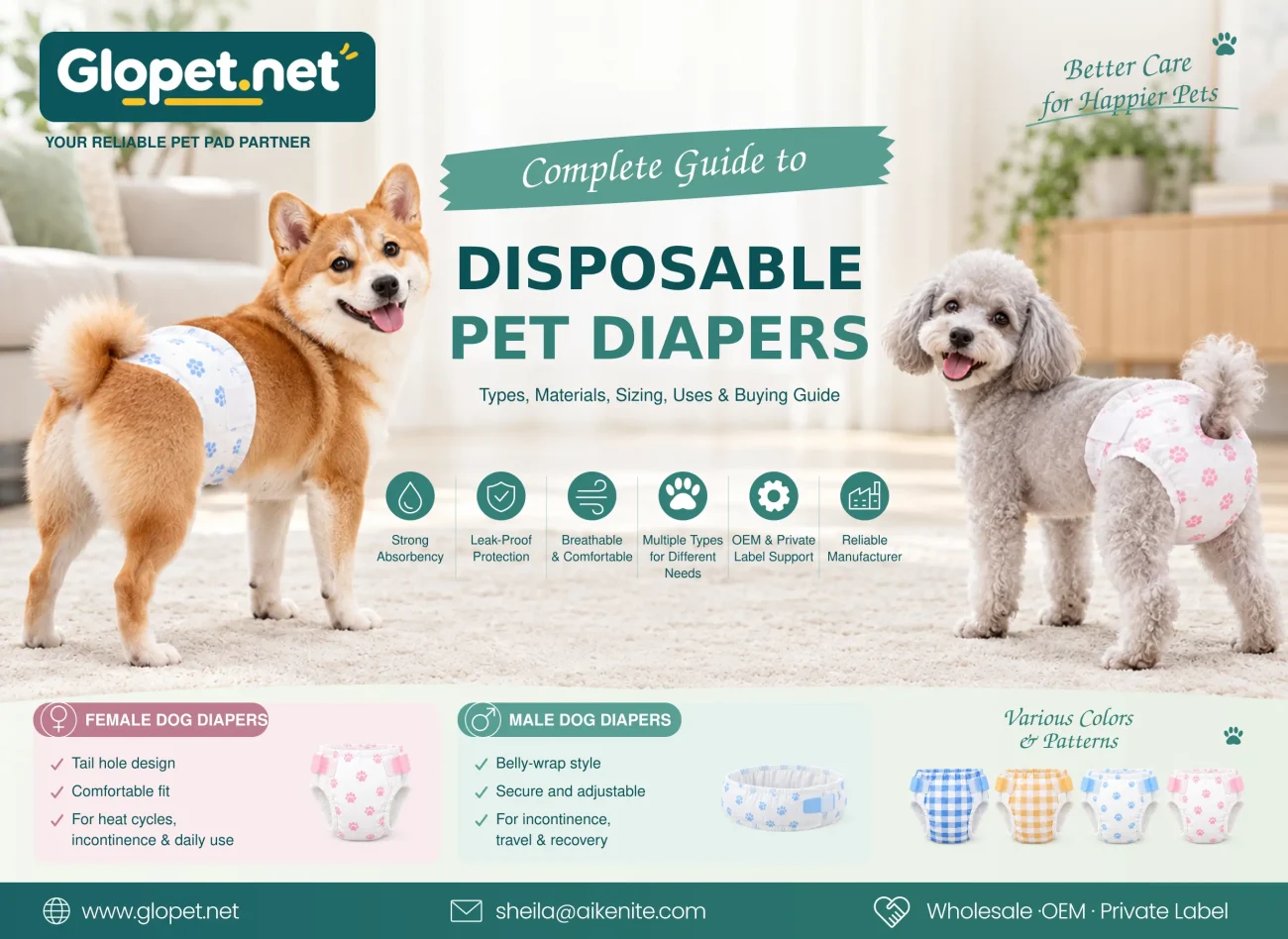
The Big Picture
Walk into any pet-care conversation and it does not take long before someone brings up disposable pet diapers. They have quietly turned into a staple of the hygiene aisle, and pet brands, wholesalers, distributors, and stores all treat them as a standard part of a well-rounded lineup these days.
The difference between a diaper and an ordinary puppy pad boils down to one idea: a diaper goes with the dog, while a pad stays where you put it. A diaper’s whole job is to hold urine, heat-cycle discharge, and travel accidents before they ever reach your customer’s sofa, floor, or car seat.
For anyone purchasing at scale, the sticker price is rarely the real deciding factor. What matters is how the item performs day after day, how trustworthy the factory is, and whether the range can be shaped around a brand.
What Actually Matters
Before you commit to a supplier, it helps to work through a short list of essentials:
• Fit and sizing
• Absorbency
• Leak-proof protection
• Material quality
• Breathability and comfort
• Fastening and adjustment
• Product consistency
• Packaging and customization
• Production capacity
• Quality control
What’s Really Inside
A disposable pet diaper is basically a wearable hygiene product built to soak up urine and keep it off your floors, furniture, bedding, and anything else in the way.
Tear one open and you usually find the same cast of layers:
• A soft nonwoven top
• An absorbent core
• Super absorbent polymer (SAP)
• Fluff pulp or another absorbent filler
• A leak-resistant sheet
• Elastic parts
• Fastening zones
• Leg or waist barriers, where the design calls for them
Everything in the build points at one target: pull in liquid fast while keeping the diaper firmly on the dog. Absorbency matters, but so do comfort, fit, leak defense, and price — and none of them works in isolation.
When a Diaper Makes Sense
1. Incontinence
Older dogs and dogs with bladder-control trouble can have accidents. A diaper absorbs the leakage and lightens the cleaning load around the house.
2. Female Dogs in Heat
Heat cycles bring discharge. A female dog diaper contains it, which makes indoor hygiene far easier to manage.
3. Travel
Hotels, cars, and trains are unforgiving when a dog has an accident. Diapers offer a quick layer of protection during any trip.
4. Puppies
House-training is still a work in progress for puppies, and mistakes happen. Training pads fit toilet training better, but a diaper helps keep a puppy clean and protected while being carried or moved.
5. Recovery
After an operation or during illness, keeping the dog and its environment clean may call for extra help. Used under veterinary guidance, a diaper can manage fluids that would otherwise spread.
6. Everyday Indoor Use
Some owners like having a diaper ready for the occasional accident. This opens space for brands to design products for daily hygiene, travel, senior pets, and female dogs.
Why Male and Female Diapers Differ
The biggest trap in this category is treating male and female diapers as two colors of the same product. The anatomy is different, and so is the design.
Female Dog Diapers
A female diaper tends to be fuller, wrapping the rear and waist to cover the right zones. Key elements include waist fit, leg opening, absorbent coverage, tail opening, fastening system, and leakage protection.
Male Dog Diapers
Male diapers more often use a belly-wrap layout, keeping the absorbent zone at the abdomen instead of copying the female structure. A factory that can supply both makes it far easier to build a complete range.
How They Do Their Job
The mechanics are easy to follow. Urine hits the top layer, passes through, and lands in the absorbent core. From there the core spreads and holds the liquid, SAP takes in a large amount relative to its own size, and the sheet blocks anything from leaking out.
A simple picture: Dog → Soft Topsheet → Absorbent Core + SAP → Waterproof Backing → Outside Surface.
In practice the whole construction decides how well this works. A pad can be stuffed with SAP and still underperform if the core is uneven, the seal is weak, or the fit is wrong.
The Raw Materials
Nonwoven Fabric
Nonwovens sit on the inside as the contact layer. Look at softness, liquid permeability, strength, comfort, and manufacturing stability.
Super Absorbent Polymer
SAP absorbs and holds liquid inside the core. It is central to modern absorbent products. Buyers should weigh SAP quality and quantity together with how the core is built, not on their own.
Fluff Pulp
Pulp helps spread moisture evenly across the core. Pairing it with SAP balances distribution and retention.
PE Waterproof Film
The outer sheet is usually a polyethylene film or similar barrier that stops liquid from reaching furniture and floors.
Elastic
Elastic around the waist or legs helps the diaper track the dog’s body and hold position.
Do Layer Counts Tell You Anything?
Not really. A higher layer count is not proof of a better product. What counts is whether each layer has a purpose and whether they work as a whole.
A typical build might look like: top layer (soft contact surface), acquisition/distribution layer (moves liquid into the core), absorbent core (holds the liquid), SAP layer (increases retention), leak-resistant sheet (helps prevent leaks), plus additional structural or barrier components depending on the design.
The useful question is not how many layers but what each layer does — and whether the assembly actually performs.
Getting the Size Right
Fit decides whether a diaper works at all. A diaper can absorb superbly and still leak if it does not fit. Suppliers usually size by waist circumference, body size, weight, breed, and male or female design. Weight is a weak guide on its own — two dogs can weigh the same yet have very different waistlines.
For both development and consumer instructions, waist circumference is the most practical measure: measure → compare with the supplier size chart → select size → test fit → adjust if necessary. Ask for real dimensions and test samples before confirming a large order.
Signs of a Good Diaper
• Secure fit — it should stay in place during normal activity
• Absorption performance — liquid should be taken in quickly and held in the core
• Leak protection — the sheet, barriers, and overall build should work together to stop leaks
• Comfortable materials — the inner surface must feel soft against the dog’s skin
• Right elasticity — a secure fit without too much pressure
• Practical fastening — easy to position and adjust
• Consistent manufacturing — dimensions, absorbent distribution, sealing, and construction stable across batches
For importers, consistency can matter even more than one strong sample.
Why Leaks Happen
• Wrong size — too large and gaps open up; too small and coverage falls short
• Poor positioning — a diaper can leak even when the size is right if it sits badly
• Capacity shortfall — the core may simply be too small for the situation
• Uneven distribution — liquid that pools instead of spreading raises the leak risk
• Weak barriers — poorly built barriers or sheet let liquid find a way out
• Activity — active dogs stress the structure and closure. Test diapers in realistic conditions, not just in the lab
Diapers vs. Training Pads
They solve different problems and belong in different parts of a catalog. A diaper is worn by the pet and focused on wearable hygiene, covering incontinence and heat-cycle management and proving useful for travel. A training pad is a surface-protection product aimed at home toilet training, with only limited use for incontinence or heat management. Carrying both gives a brand a more complete portfolio.
Disposable vs. Washable
The right choice depends on the customer. Disposable diapers are thrown away after use, need no washing, are easy for travel, and deliver a fresh product every time — convenient for shoppers. Washable diapers are reusable, potentially create less waste over time, and suit customers who prefer reusable options. For B2B brands, disposables appeal strongly to customers who value convenience and hygiene.
What to Check in a Supplier
• Manufacturing capability — does the supplier run its own lines and keep stable capacity?
• Product range — offering both male and female diapers simplifies sourcing
• Quality control — ask about material checks, in-line checks, finished-goods checks, and batch consistency
• Absorbency testing — the supplier should be able to demonstrate absorbency and leak testing
• OEM and private label — confirm support for custom packaging, private-label products, custom sizes, colors, printing, product combinations, and retail-ready packaging
• MOQ — the minimum order should fit your sales plan and inventory
• Samples — always test samples before bulk production
Buying in Volume
Product selection should track the market you serve. For female dog diapers, look at multiple sizes, different fastening designs, different patterns or colors, and tail-hole options where applicable. For male dog diapers, consider belly-wrap designs, multiple sizes, different patterns or colors, and adjustable fastening. A wider size range lets distributors serve more breeds and customer groups.
OEM and Private Label
Diapers suit private-label programs well. A typical project runs: product selection → sample testing → specification confirmation → packaging design → pre-production confirmation → mass production → quality inspection → packing → shipment.
Customization can cover product size, product design, pattern, color, packaging, sheet count, label, carton design, and retail presentation. For new brands, starting with a clear specification is safer than customizing everything at once.
Evaluating Samples
Put together a simple checklist before any bulk order.
Product checklist: correct size, correct product type, comfortable inner surface, secure fastening, appropriate elasticity, good absorbency, acceptable drying and retention, no obvious leakage, consistent dimensions, and good overall appearance.
Supplier checklist: factory and manufacturing capability, quality-control process, stable raw material supply, OEM and private-label capability, appropriate MOQ, reliable lead time, export experience, and clear communication. A structured review makes comparing suppliers much easier.
Matching Diapers to a Brand Strategy
For Amazon Sellers
Attractive packaging, clear sizing, product differentiation, multiple sizes, strong product photography, and reliable replenishment.
For Wholesalers
Competitive unit cost, stable production, multiple product options, carton efficiency, consistent quality, and flexible order quantities.
For Distributors
Market-specific selection, private labeling, product range expansion, reliable supply, and long-term cooperation.
For Established Pet Brands
Product customization, packaging consistency, new product development, OEM manufacturing, and supply-chain stability.
A Category Still Rising
Owners want convenience in every corner of pet care. Training pads still anchor home hygiene and puppy training, but diapers answer needs they cannot. That is why a growing number of brands carry both — pads for the home and diapers for travel, heat, or incontinence.
The Glopet Diaper Range
At the Glopet factory, we moved from training pads into disposable dog diapers, giving B2B buyers more sourcing options. Our range covers male dog diapers and female dog diapers, with designs including blue check plaid, blue dot, blue paw print, orange check plaid, orange dot, and pink paw print. The lineup serves different hygiene needs and gives wholesalers, distributors, importers, and brands more room to grow.
We also support wholesale, OEM, and private-label cooperation, so customers can shape products and packaging for their market.
FAQ
Can both male and female dogs use disposable diapers?
Yes, but male and female diapers generally use different designs to suit different body structures and hygiene needs.
How do I choose the right size?
Measure the dog’s waist and compare it with the manufacturer’s chart. Weight helps, but waist measurement is more reliable.
Are diapers the same as training pads?
No. Pads sit on a surface; diapers are worn by the pet. They serve different purposes.
Can dogs wear diapers while traveling?
Yes. Diapers help manage accidents and keep the environment clean on the move.
What is SAP?
Super Absorbent Polymer, an absorbent material that holds liquid inside the diaper’s core.
Can diapers be customized?
Many manufacturers offer OEM and private-label options, including packaging, sizes, colors, patterns, and more.
Should I test samples first?
Yes. Evaluate fit, absorbency, leak protection, materials, fastening, and consistency before mass production.
Final Word
Disposable pet diapers are an increasingly important part of the pet hygiene market, especially for brands covering more than basic toilet training. The best product is rarely the cheapest or the one with the biggest absorbency claim. What wins is a practical balance of fit, comfort, absorbency, leak defense, material quality, production consistency, and dependable supply.
Working with a supplier that offers both male and female diapers can also simplify development and supply-chain management. If you are sourcing diapers for wholesale, OEM, or private label, test samples and review the factory’s capability before you commit.
Looking for a disposable pet diaper manufacturer? Reach out to the Glopet team for specifications, samples, wholesale pricing, and OEM or private-label solutions.