
Start With the Right Mindset
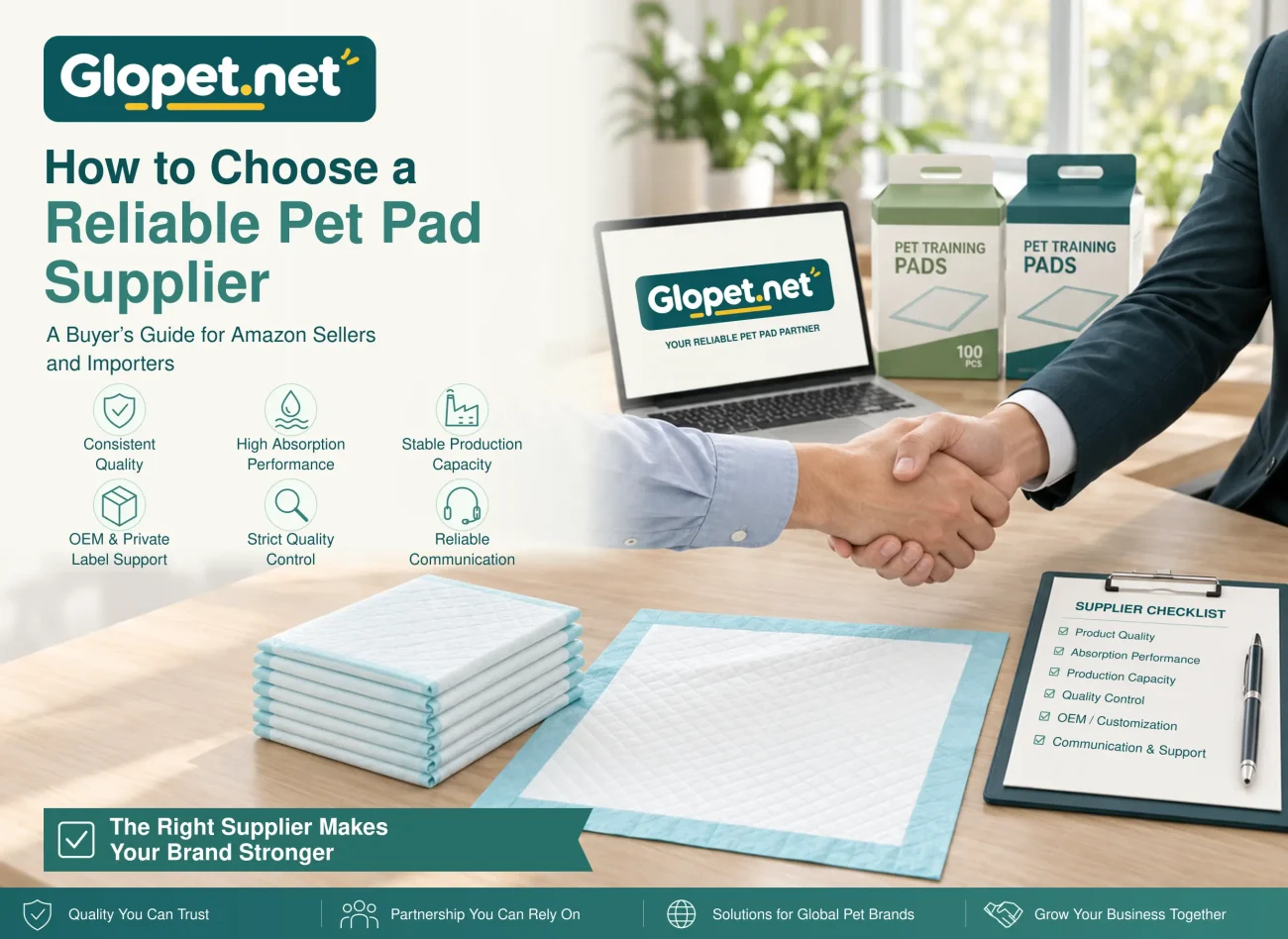
Sourcing pet pads is not the same as shopping for the lowest number on a quote. Amazon sellers, wholesalers, distributors, and importers have to look at product consistency, absorption behavior, production capacity, quality management, OEM support, and communication before they place a serious order.
A factory that nails a single prototype but cannot hold that standard across a whole production run can cause much bigger trouble down the road. For a brand in expansion, the right partner is usually not the one quoting the smallest price. It is the one that delivers the product customers expect, run after run, while scaling as order volumes grow.
What Matters Most
• Judge product quality and consistency rather than being won over by one sample.
• Look at absorption behavior instead of trusting weight or thickness figures alone.
• Verify production capacity and supply stability before ordering in volume.
• Find out how raw materials, production batches, finished goods, and packaging are checked.
• Confirm OEM, ODM, and private-label support if you plan to customize.
• Choose a partner on overall value, communication, and long-term dependability rather than price.
Where to Begin
On paper, a disposable pet training pad looks like a simple product — basically a topsheet, an absorbent core, a waterproof sheet, and packaging. But anyone who buys pads in volume quickly discovers that small differences in materials and production show up as large differences in behavior.
One batch may soak up liquid fast while the next feels slower. Two pads can look almost the same yet differ in SAP distribution, core layout, edge sealing, or sheet quality. These variations matter even more for Amazon sellers, where customer reviews make inconsistent quality obvious almost immediately. For importers and private-label brands, choosing a manufacturer should therefore be treated as a sourcing decision, not a price negotiation.
1. Look Past the Sample and Chase Consistency
A strong sample matters, but it only shows what one piece can do. A common error is to see an impressive sample, approve it, and then assume every production run will match it. A serious manufacturer should be able to repeat the same specs throughout production.
When you evaluate a partner, ask about raw material consistency, pad dimensions and weight, SAP and absorbent core structure, topsheet quality, PE sheet performance, edge sealing, folding and packaging, and inspection between batches. Consistency matters most for Amazon sellers — no shopper buys Batch A or Batch B; they buy a brand. If the product behaves differently from one order to the next, the customer holds the brand responsible, not the factory.
2. Judge Absorption, Not Just Weight
Extra weight does not guarantee a better pad. Performance comes from how the materials behave together in daily use. The absorbent core usually combines materials such as fluff pulp and Super Absorbent Polymer (SAP). How the core is structured and distributed decides how quickly liquid passes through the topsheet and how well moisture is held.
Instead of asking only, What is the gram weight? ask more practical questions: How fast does it absorb? Does the liquid spread evenly? Does the surface stay reasonably dry after absorption? How well does the core hold liquid? Does the pad keep its shape after absorbing moisture? The right spec also depends on your target market — an economy pad for high-volume retail does not need the same construction as a premium pad for large dogs or heavy indoor use. A good manufacturer should discuss these trade-offs openly rather than pushing the priciest option.
3. Confirm the Factory’s Capacity
Capacity becomes the deciding factor once your product starts selling well. A manufacturer can easily handle a few sample cartons. The real question is whether it can keep up as demand grows. Review these areas before you commit.
Production Capability
Can the factory cover your expected order volume? Ask about the number of production lines, typical order sizes, and how schedules are handled during peak seasons.
Raw Material Supply
A steady supply of key inputs keeps production consistent. Fluctuations in material availability can affect lead times and specifications.
Production Scheduling
Ask for realistic lead times covering samples, packaging preparation, production, and shipment.
Packaging Capacity
For a private-label brand, the manufacturer should coordinate packaging, cartons, labels, and other customized needs.
Scalability
If your Amazon sales double, can the factory raise output without hurting consistency? This point matters a lot for growing brands. Changing manufacturers after your product has traction is expensive — packaging may need to be redesigned, samples re-approved, and customers may notice product differences. It is usually smarter to pick a partner that can grow with you from day one.
4. Ask How Quality Control Really Works
Quality is easy to claim and harder to prove. The more telling question is not whether the factory says it has good quality, but how it actually verifies it. A dependable pet pad manufacturer should run checks at several points along the line rather than leaving everything to one final look.
Depending on the product and your requirements, buyers may want to discuss incoming raw material inspection, material weight and dimensions, absorbent core consistency, product size, absorption performance, leakage protection, edge sealing, folding accuracy, packaging quantity, and finished-product inspection.
For private-label customers, confirm that the manufacturer can follow your approved specifications. If you have a specific pad size, packaging count, absorbency requirement, or material structure, pin those down before mass production. The aim is straightforward: what gets approved should be what gets made in volume.
5. Confirm OEM and Private-Label Support
Not every Amazon seller is shopping for a plain puppy pad. Many are building a brand, and that changes what they need from a manufacturer. A useful OEM pet pad partner should be able to discuss customization such as pad size, product weight, absorbency level, packaging quantity, printed packaging, private-label branding, scented options, charcoal odor-control options, and other product specifications.
For example, one brand may want a basic everyday training pad positioned around value, another may want a premium product with odor control, while a third may want scented pads. The manufacturing partner needs to understand these differences. OEM is not just putting a logo on a box; good OEM cooperation starts with matching the product structure to the brand’s target customer and price positioning.
6. Don’t Let Price Be the Only Factor
Price will always matter in B2B buying, but the lowest quote does not always mean the lowest total cost. Consider two manufacturers: Vendor A offers a lower unit price but inconsistent quality; Vendor B costs a little more yet provides stable production, better communication, dependable packaging, and consistent performance. If Vendor A generates complaints, returns, negative reviews, or delayed shipments, the apparent price advantage evaporates quickly.
For Amazon sellers, the damage from a poor product can go well beyond the purchase order — affecting customer reviews, product ratings, return rates, advertising performance, brand reputation, and repeat purchases. A more sensible approach is to compare total sourcing value rather than unit price alone.
7. Test Communication Before a Large Order
Communication is easy to skip and hard to value. You can learn a great deal about a manufacturer before signing a big purchase order. Watch how the manufacturer responds to technical questions: Do they understand the difference between SAP content and total product weight? Can they explain the available pad structures? Can they discuss packaging specifications clearly? Can they provide samples? Do they answer questions directly? Can they give realistic production and shipping schedules?
A factory does not have to agree with every request. In fact, a good manufacturer may tell you when a specification is impractical or needlessly expensive. That kind of honest communication can be worth more than a low quotation.
8. Make Sure the Manufacturer Understands Your Market
A pad built for a discount retailer may not suit a premium Amazon brand. Before asking for a quotation, define your market:
• Amazon value brand — competitive cost and reliable basic performance
• Premium pet brand — absorption, comfort, and packaging
• Multi-pet households — higher absorption and odor control
• Pet stores — product differentiation and retail packaging
• Wholesale distributor — stable supply and competitive pricing
• Private-label brand — customization, packaging, and consistency
A good pet pad manufacturer should be able to discuss these differences with you. This is where experience pays off — instead of selling whatever is on hand, the manufacturer can help you choose a specification that fits your market.
9. Request Samples Before Bulk Production
Never rely entirely on product photos or a specification sheet. Ask for samples and examine the real product. Depending on your business, you may want to check overall dimensions, folding, topsheet feel, absorption speed, liquid retention, sheet performance, edge sealing, packaging, and product consistency.
If possible, compare samples from several manufacturers under the same test conditions. That gives you a far clearer picture than comparing quotations alone. For private-label products, it is also wise to approve the final packaging artwork and product specification before mass production begins.
Why Glopet Can Be a Long-Term Partner
For global pet brands, sourcing is about more than finding a factory that can make pet pads. It is about finding a partner that can support the business beyond the first order. At Glopet we focus on disposable pet hygiene products and serve wholesale, OEM, and private-label customers. Our range includes standard disposable pet training pads as well as differentiated options such as scented pet training pads and charcoal odor-control pet pads. We also support customized product specifications and private-label packaging for customers building their own pet product brands.
For buyers, the objective is straightforward: consistent products, dependable production, and a partner that values long-term cooperation. If you are looking for a pet pad manufacturer for wholesale, OEM, or private-label projects, Glopet can provide product development and manufacturing solutions for different market requirements. Contact us for samples, product specifications, and OEM cooperation.
FAQ: Choosing a Pet Pad Manufacturer
What should I look for in a pet pad manufacturer?
Begin with product consistency, absorption performance, production capacity, quality control, OEM capability, and communication. Treat price as one factor among these, not a standalone measure.
How do I compare samples from different manufacturers?
Test every sample under identical conditions. Compare size, weight, absorption speed, liquid retention, leakage protection, surface behavior, folding, and packaging.
Is a heavier pet pad always better?
No. Weight alone does not determine performance. Material composition, absorbent core structure, SAP distribution, and overall design also influence how a pad performs.
Can manufacturers provide private-label packaging?
Many OEM manufacturers can. Buyers should confirm available packaging formats, printing options, minimum order quantities, artwork requirements, and production lead times before ordering.
What is the difference between a manufacturer and a trading company?
A manufacturer controls or directly manages production, while a trading company may source from various factories. For long-term OEM work, buyers often benefit from dealing directly with a manufacturer, where communication and product development are more direct.
Should Amazon sellers choose a China pet pad manufacturer?
China has a large manufacturing base for disposable hygiene products, but location alone does not guarantee quality. Amazon sellers should evaluate each manufacturer’s production capability, quality system, consistency, communication, and OEM experience.
Final Thoughts
Finding the right pet pad manufacturer takes more than comparing five quotes in a spreadsheet. For Amazon sellers, importers, distributors, and private-label brands, the real questions are: Can the manufacturer make the product consistently? Can they keep quality up as order volumes grow? Can they tailor the product around your market? Can they communicate clearly when problems arise? Can you see yourself working with them for years to come?
A reliable manufacturer should support more than your first shipment. The right partner can become part of your product development and supply-chain strategy as your brand expands. If you are looking for a pet pad manufacturer for wholesale, OEM, or private-label projects, contact Glopet to discuss your requirements.